
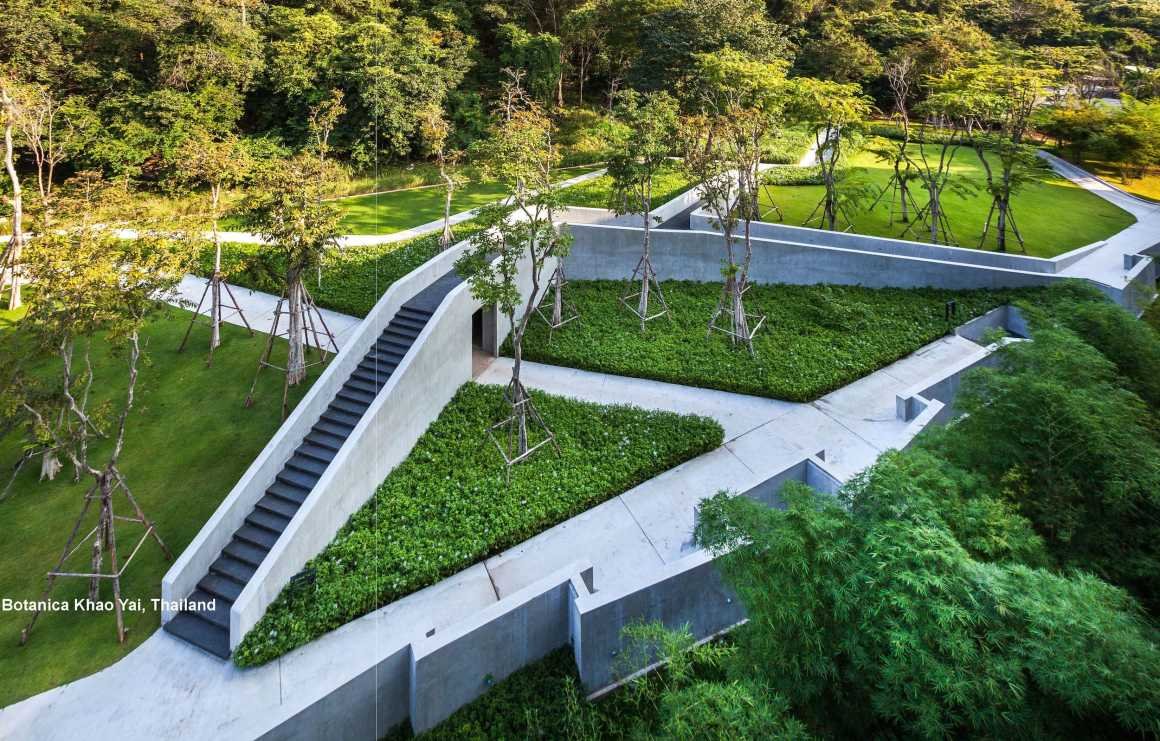


TROP:Terrains+Open Space : 项目设计受附近山脉,泰国最大的雨林——考艾的启发,景观成为建筑与自然之间的联系。我们不希望制造出一个模拟的自然森林,于是将建筑诠释为大树,而景观代表林下空间。景观解决方案成功地引入了在不同的阳光条件下人为的可持续森林,激发居民理解和欣赏大自然的一切。
TROP:Terrains+Open Space : Inspired by the nearby mountain range, Khao Yai, Thailand’s largest rain forest, the landscape is created as the link between the architecture and Nature. Instead of trying to produce a faked natural forest, the architecture is interpreted as big trees while the landscape represents the green areas underneath. Working with different qualities of sunlight, the landscape solution successfully introduces the man-made sustainable forest, which inspires the residents to understand and appreciate what Nature is all about.
平面图 Plan
Botanica考艾位于泰国最重要的国家自然保护区——考艾的边缘。场地曾经是一个废弃的农地。场地前方是一条当地的道路,场地的背后是一座小山,毗邻国家公园的边界。整个场地分为2个主要的地块,前面的在道路旁边的是住宅区,而第二个在山的旁边的,被保留为居民和游客娱乐活动的公共公园。
Botanica Khao Yai is located on the edge of Khao Yai, the most important national reserve forested region of Thailand. The site was an abandoned agricultural land. On the front, it faces a local road, and, on the back, a small mountain just right next to the boundary line. Separated into 2 main plots, the front plot, next to the road, is the residential area, while the second plot, next to the mountain, is reserved as a public park for recreational activities of the residents and visitors.
为了将所有的单元要求都安排在一个紧凑的区域,“住宅”,一系列的住宅区,被安排在景观平台上。两座6层高的建筑,被称为A座和B座,位于两个地块的边缘。块B是一个简单的6层高的住宅单元,而块a稍微复杂一点,它有V型布局。街区的一部分有6层楼,面对着山。另一部分位于第一个地块的中间,从地面上升4层,只在最高的两层,面对着房子的前方。这些高架建筑是在巨大的混凝土柱上建造的,留下了巨大的桥下空间。沿着这条路,有12幢2层的别墅,每一个都带有私人花园和游泳池。
In order to fit all unit requirements into a compact area, ‘The Residences’, a series of residential blocks, were arranged on the landscape platform. Two 6-storey buildings, called Block A and Block B, are located along the edge between 2 land plots. Block B is a simple 6-storey residential block, while Block A is a bit more complicated. It has a V Shape layout. One part of the block has units for all 6 floors, facing the mountain behind. The other part is located in the middle of the first plot, elevated 4 floors from the ground with units only on the top 2 floors, facing the front of the property. The elevated units are built on gigantic concrete columns, leaving space underneath as big opening void. Along the road, 12 2-storey villas are created, with private gardens and pools.
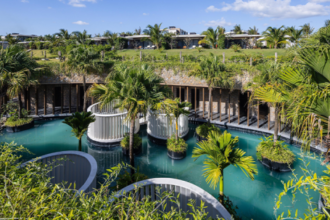
尽管我们在考艾看到了类似现代建筑和几何设计的氛围,但因为每座建筑都有不同的高度,有些单元体架在高柱子上,不同的阳光品质由此产生。阳光的可用性成为我们在这里重建森林景观的主要标准。高高的圆柱上的浮动单元让我们想起了森林里的高大乔木。每一根柱子的大小和树干差不多,上面的单元体让我们想起树冠的形态。下面的区域与我们在树下发现的环境非常相似,尽管它缺乏阳光,但大自然却在这种艰苦的环境下茁壮成长,以便生存。我们模仿了这种自然条件,在阴影区域内创建了绿色的地形,并且用在森林里发现的当地蕨类植物被用来掩盖地貌,我们称这一部分为蕨山。
Despite the architecture’s modern and geometrical design, we saw a similar atmosphere found in Khao Yai. Because each building has different height, some units elevated on tall columns, a different variety of sunlight qualities are created through out the project. Sunlight availabilities became the main criteria that we used to re-create a forest-like landscape here. The floating units on tall columns reminded us of gigantic trees in the forest. Each column is about the same size as the trunks of those trees, and the units above reminded us of the canopies. The area underneath is very similar to conditions we found under the trees, which, despite of its lack of sunlight, Nature has found its way to thrive under this hard condition in order to survive. Imitating this natural condition, Topographic green landforms were created in the shaded area. Local Ferns, found in the forest, were used to cover up the landform, called the Fern Hills.
该地区的主要行人交通被称为“道路”,它比蕨山的标高略高,它左右摇摆,上下起伏,使居民可以在区域环境中选择自己的路线。这条路不仅仅是一个主干道,也是一个休闲区,居民可以在那里锻炼或散步,体验与自然的直接接触。这条小路也与公共区域相连,比如大堂、会所、电梯厅和走廊,这些都是在户外并且不使用空调,取而代之的是一种凉爽而阴暗的环境。自然采光也被整合到项目中。我们选择当地的材料来协调建筑和景观。这些材料很容易在当地获得,比如在地下室施工时发现的山石。
The main pedestrian circulation of the area is called ‘The Path’. Raised a bit above the Fern Hills, it serpentines left and right, up and down through out the landscape, enabling residents to choose their own routes amidst natural surroundings to their accommodations. More than being just a movement artery, the Path is also a recreational area, where residents could exercise or take a leisure walk and experience direct contact with Nature. The Path is also linked to the public areas such as lobby, clubhouse, lift hall and corridors, all designed as open-air without using air condition, instead creating a cool and shady environment with large trees. Natural lighting is also integrated into the entire project. Local materials were selected to harmonize the architecture and the landscape. These materials can easily be acquired locally such as mountain stones, found at the site during basement construction.
在第二个地块上,我们设计了一个“公园”,作为吸引所有居民和游客的休闲放松的地方。邻近的山毗邻森林公园的边界,为了防止洪水和土地滑坡,我们精心布置了三层地下排水系统。在旱季,雨水被收集并用于灌溉。一系列的景观功能区块都设置在这片场地。这里有一个竹林掩藏的餐厅,是为规划公园的边界而设计的。在山脚下,一座绿色的小山被整合成一个倒影池,展示了人造景观和自然景观之间的一些对比。然而,随着山的倒影,它们无缝地结合在一起。我们还设计了两个游泳池。第一个游泳池位于健身房和休息室的顶层。它的镜面水面掩盖了下面巨大的结构,使它完全消失。第二个游泳池在公园中央,它的水倒映着周围的环境,山和建筑,所有的元素结合在一起作为整体景观的一部分。鼓励健康生活是我们设计住宅景观的主要目标之一。公园右侧也有一条慢跑跑道。为了达到跑道的最大长度,将抬高的慢跑桥作为一种工具来增加跑步者的路线选择。慢跑道的形状也与周围的山脉轮廓相呼应。
On the second land plot, ‘The Park’ was created as the recreational attraction for all residents and visitors. With the neighboring mountain, right next to the boundary, 3 layers of sub-drainage systems were carefully prepared to prevent flood and land slide. Excessive rainwater is harvested and collected for irrigational uses during the dry season. A variety of landscape programs have been introduced to the property. The Dining Pavilion, hidden by bamboo forest, was designed to frame the boundary of the Park. At the base of the mountain, a green hill was integrated into a reflecting pond, demonstrating some contrast between Manmade and Natural landscape. Yet, with the reflection of the mountain, it unites both together seamlessly. 2 swimming pools were also proposed. The first pool was located on top of a gym and a lounge. Its reflective water camouflages the massive structure underneath, making it totally disappeared. The second pool was created in the middle of the Park. Its water also reflects the surroundings, both the mountain and the architecture, combining all together as part of the overall landscape. Encouraging the good health is one of our main objectives designing the residential landscape. A Jogging Track is also proposed on the right side of the Park. Trying to achieve the maximum length of the running track, an elevated jogging bridge is introduced as a tool to multiply the routing options for the runners. Its shape also echoes the mountainous skyline of the surrounding areas.
整个设计团队在一个现代的背景下做出了设计,但仍然保持了一种热带氛围的本质。这是通过仔细考虑合适的布局来实现的,以确保居民能够看到考艾美丽的全景。我们认为,当代设计并不一定要与自然对立。这一概念的目的在于创造友好的森林,以减少粗糙的人为结构形式,从而将建筑和周围的自然环境整合为一体。
Overall the design team has developed designs within a contemporary context, but still keeping intact the essence of a tropical feeling and atmosphere. This is achieved through a careful consideration of appropriate layout to ensure that the residents are able to see the beautiful panoramic-scape of Khao Yai. We believe that contemporary design does not have to be in opposition to nature. The intention for the concept is to create the friendly Forest in order to reduce the harshness of man-made structural form, thus, integrating the building and surrounding nature as one.
景观设计: TROP: terrains + open space
业主: The Scenical Development Company Limited
建筑设计: Vin Varavarn Architects Co., Ltd.
室内设计: Define Studio Co., Ltd., Mada Design Factory Co., Ltd.
摄影: Spaceshift Studio Pirak Anurakyawachon, Aranyarat Prathomrat
Landscape design: TROP: terrains + open space
Client: The Scenical Development Company Limited
Architecture design: Vin Varavarn Architects Co., Ltd.
Interior design: Define Studio Co., Ltd., Mada Design Factory Co., Ltd.
Photographer: Spaceshift Studio Pirak Anurakyawachon, Aranyarat Prathomrat
更多:TROP : terrains + open space
Nguồn: mooool