


During the last several decades, the rapid economic growth and urbanization of cities in developing nations have meant that would-be city dwellers have had to make do with less and less space to live in. On the other hand, experts say that cities offer better opportunities for climate adaptation, as they are more efficient in providing resilience-promoting infrastructure and services due to their density. However, with a projected 90 percent of urban increase in population expected to occur in the cities of developing countries, policymakers and citizens will have to reimagine what it means to live comfortably and sustainably in these growing urban areas.
The megacity of Bangkok, Thailand, is a perfect example of how it could be done. City officials recently gave the go-ahead for urban greening projects that will not only increase the amount of green space per capita and individuals’ well-being but also lower the city’s carbon emissions.
On a smaller scale, local designers like Mae Prachasilcha of La Tarta Piccola are working in their own way to promote sustainable, small-space living. Most recently, the interior designer transformed a 355-square-foot (33-square-meter) condo from a cramped, boring box into a zen-like, multifunctional haven for her brother and sister-in-law, as we can see in this short tour from Never Too Small:
The makeover took its cues from traditional Japanese inns that are much like the bed-and-breakfast variety and are often built with customary architectural elements like paper screen doors (shoji) and modular tatami mats. But rather than using them as mere window dressing, these components are used to maximize the small space effectively, and to further the idea of tranquil living, says Prachasilcha:
“The design idea was to optimize the use of limited space by overlapping functional spaces. The design was inspired by the calm and peaceful vibes of Japanese ryokans, or hot spring inns. We wanted to use Japanese shoji doors to give the space a softer look, and to also allow for flexibility. In doing so, we were able to create two multifunctional areas that expands the living area from 7 to 17 square meters (75 to 183 square feet).”
Never Too Small
The apartment is located at Lat Phrao Intersection, a huge road junction in Bangkok. The entrance to the apartment opens into a space that has integrated storage on one side. This built-in cabinet floats above the floor, cleverly creating a brightly lit space below for shoes.
Never Too Small
On the other side is a small but well-illuminated desk for working from home.
Never Too Small
Just beside the entry is the kitchen, which can be found behind a sliding door. As Prachasilcha explains, there was no budget to renovate the kitchen, so it was left as-is, but it still is very functional in terms of use and storage space.
Never Too Small
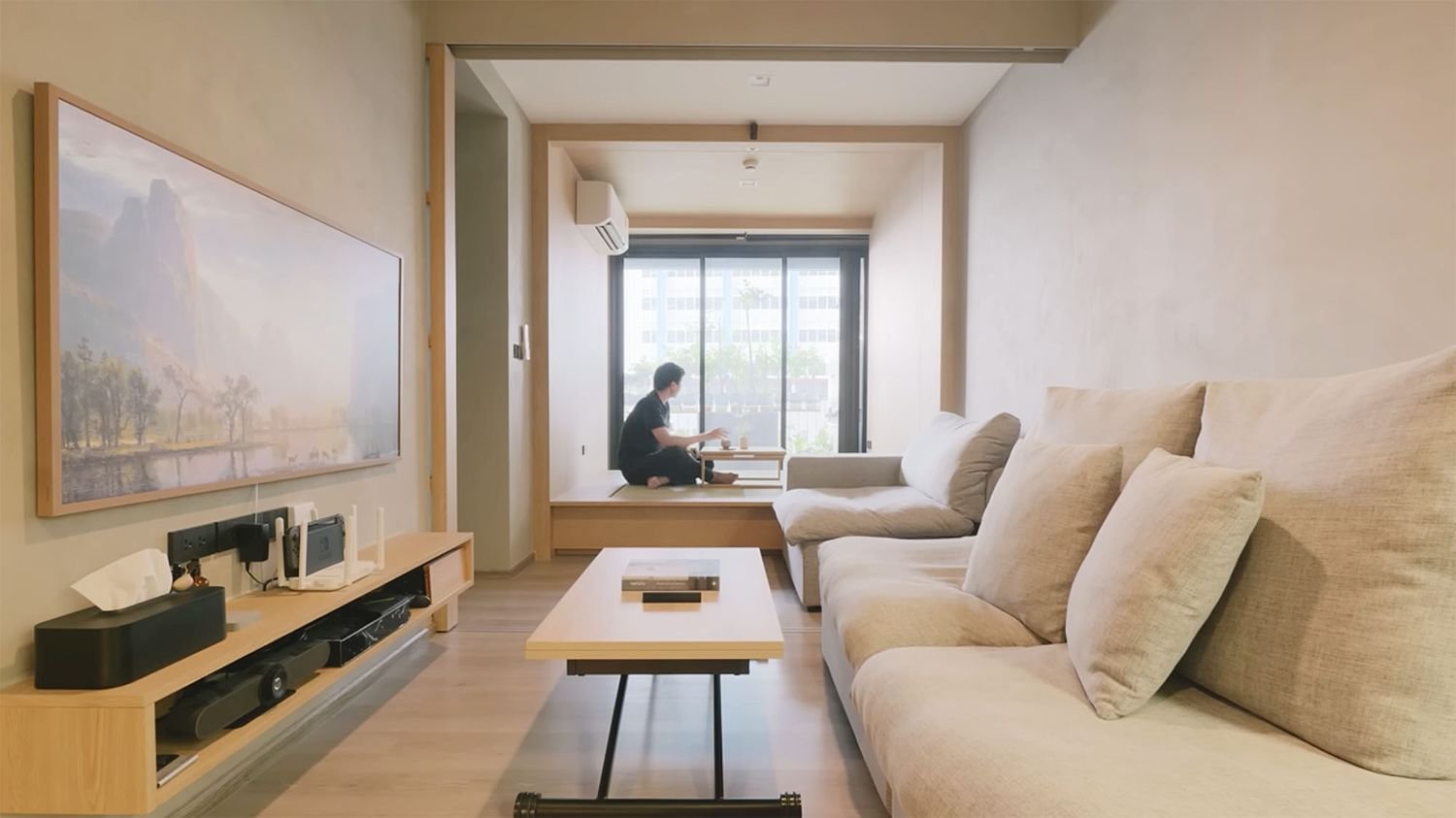
Back out into the main living space, we come into the living room, which is furnished with a comfy couch, and a custom-made media center.
Never Too Small
The coffee table here is designed to lift and open up, creating a cozy dining table for a few guests.
Never Too Small
Beyond that, we have the star of this show—a set of huge sliding shoji doors. When closed, they hide the couple’s wardrobe, located in a hallway that leads to the bathroom, and at the same time, open up the blended living and sleeping spaces.
Never Too Small
The sleeping space is also a multifunctional space, laid out to suggest the modularity of tatami modules. It’s intended as a flexible space that could be used for sitting, working, reading, or drinking tea. This area also looks out of the apartment’s balcony, which has been populated by some houseplants.
Never Too Small
Underneath the tatami, we find integrated storage cubbies for putting away the low table or the futon.
Never Too Small
When the big screen doors are closed, the futon can be rolled out, and the space is made cozy for sleeping.
Never Too Small
At the other end, we also have the bathroom, clad almost entirely in elegant, dark tiles.
Never Too Small
The overlapping spaces—mediated and altered by sliding doors—are an elegant solution to making the most out of what would have been an inflexible, small space. As cities absorb more people looking to benefit from all that these urban hubs can offer, it’s important to find ways to enable and promote small-space living, says Prachasilcha:
“I think living in a small space makes life simpler, and supports a sustainable lifestyle. You will buy and keep only what you really need. It also helps to reduce one’s carbon footprint, as well as saving on electricity bills.”
To see more, visit La Tarta Piccola.